

You can find a roof leak source with a clear plan. You should notice the water uphill from the stain. The stain on your ceiling rarely sits under the hole in your roof. The pipes, and roof deck are the first things that water slides along. Then it drops into your room. Insurance data shows why speed matters. Water damage and freezing made up 27.6% of homeowner claims in 2022, according to the Insurance Information Institute.
Where Does the Water Travel After It Slips Under the Shingle?
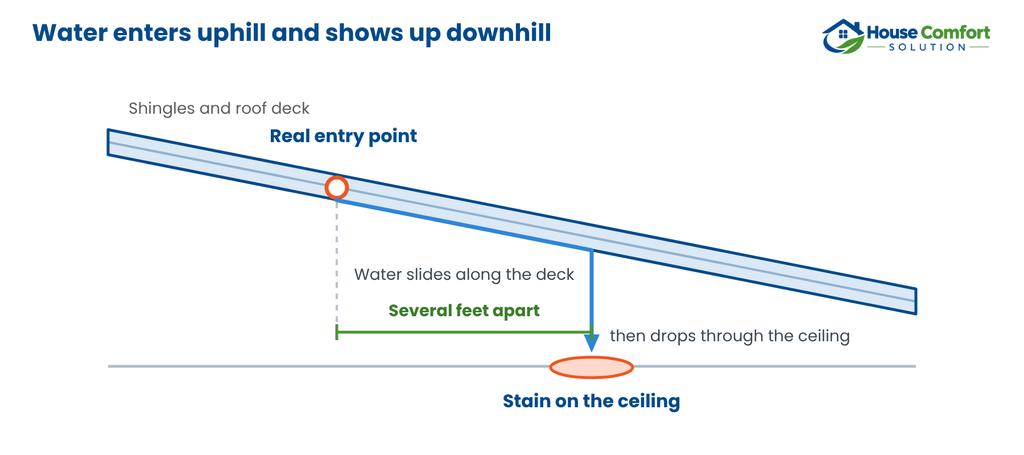
Water does not fall straight down. It slides along the roof deck. Then it drops through a seam, a nail hole, or a gap. Next, it runs down a rafter, soaks the insulation and spreads across the drywall. A company that makes shingles says that water can first pool on the attic floor. It leaves where it can, such as a soffit vent or a light fixture. A stain in your living room can sit several feet from the real hole. A path of water goes from the hole in the roof to the stain on the ceiling. 1 path, 1 stain. The hole sits uphill. The stain sits downhill.
What Does a Roof Leak Look Like Before It Drips?
You can spot most leaks before the first drip. You should look for the signs below.
• Yellow or brown rings on the ceiling
• Paint that bubbles or peels
• Drywall that feels damp or soft
• You smell mustiness in the attic or upper rooms
• Dark nail tips or wet insulation in the attic
• Warped trim near a skylight or an outer wall
A ring that grows after each rain points to a repeat leak. You should circle the stain with a pencil and add the date.
Is That Really Rain Coming Through Your Roof?
It might not be. Condensation and plumbing leaks leave the same stain. You should check the timing first.
• When it rains or after it rains, a roof becomes leaking
• A plumbing leak grows when you run water, rain or not
• It on nail tips and makes beads or frost when it’s cold outside
A wet ceiling under dry attic wood points away from the roof. You should then call a plumber or an HVAC tech. A bath fan duct or an air conditioner drain pan can also drip onto a ceiling.
What Should You Do Before You Start the Hunt?
You should limit the damage and gear up first.
• A bucket under the drip
• Rugs and furniture out of the room
• The breaker off for any wet light fixture
• A board across two joists before you step in the attic
• Gloves, goggles, an N95 mask and a flashlight
According to the EPA’s mold and moisture guide said wet materials should dry within 24 to 48 hours. You should stay out of the attic if the insulation might hold asbestos. A soaked ceiling can fall without warning. You should never puncture it unless a pro tells you to.
How Do You Follow a Wet Trail Across the Attic Beams?
After rains, or while it’s still raining, you should climb with a flashlight. It is important to start above the stain and work uphill. You should find or record five things.
1. Dark wood, wet insulation and black nail tips
2. A water trail that leads toward the roof peak
3. Pinpoints of daylight through the deck
4. A chalk circle and a photo of the spot
5. The distance from the nearest roof edge
You might find a dark streak two feet above your stain. It leads uphill to a plumbing vent. That boot is your first suspect.
How Do You Hunt a Leak When No Attic Sits Above the Ceiling?
Many homes have vaulted ceilings or sealed attics. At this time, some builders now make attics harder to reach. You can still work from the room and the yard.
1. A stain map with its size and its distance from the nearest outer wall
2. A look uphill from the stain with binoculars
3. A check of vents, chimneys, skylights and valleys on that line
4. A look at the roof-to-wall joint above the stain
You should then run the hose test below. You should call a pro if the roof is steep or wet.
Which Spots on Your Roof Break First?
Flashing joints, Penetrations like chimneys and vent pipes, and roof valleys these are the first main spots on a roof that degrade, leak and break. Shingles cover the most ground, yet a flat roof almost never leaks in the center. The roof instead cracks at the point of a roof modification or a cut.
| Roof type | Check first |
| Shingle | Flashing, vent boots, valleys, nail pops, cracked or curled shingles |
| Metal | Loose fasteners, worn washers, seams and panel laps |
| Tile | Cracked or slipped tiles and the underlayment below |
| Flat | Seams, drains, puddles and edge details |
How Do You Rain on One Patch of Roof at a Time?
You can’t make it rain in one spot naturally, but you can use controlled tools to make it look like rain and direct water to only one spot on a roof. This is often done to check for leaks, drainage, or a specific repair.
Five rules keep the test clean.
1. A gentle stream, never a pressure washer
2. The lowest part of the suspect area first
3. One zone of 10 to 15 square feet at a time
4. About 10 to 15 minutes per zone
5. A written log of each zone
The helper calls out at the first drip. That zone holds the leak. If you wet the whole roof at once, you cannot tell which zone leaks.
How Does a Pro See Water Hiding Under the Roof?
To find water hiding under a roof without tearing it apart, professionals use special diagnostic tools that don’t hurt the roof and methodical tracing techniques.
- Thermal Camera: Temperature differences can be seen by these cameras because wet insulation and materials hold and release heat in different ways than dry areas.
- Electronic leak detection (ELD): ELD uses a low-voltage electrical field to find conductive paths where water has broken through the waterproofing layer. It is mostly used on membrane or flat roofs.
- Moisture meter: Technicians press these pin- or pin-less meters against drywall, wood decking, and frames to find out the exact level.
- Nuclear Moisture Scanners: These non-destructive tools check for saturated insulation under commercial or low-slope systems by measuring how much low-level radiation is absorbed by in trapped water.
- Water Testing: Professionals use a garden hose to slowly make it rain on certain parts of the roof while an assistant checks the ceiling or attic for drips.
When Should You Put the Flashlight Down and Call a Roofer?
If you notice any light through the roof boards, if you see water dripping or dark water stains in your attic or ceilings, and you notice sagging and soft spots on the inside of the building. Put the flashlight down or immediately call the roofing expert.
Seal Failures or Flashing: If you notice valleys are cracked, rusted, vents, warped, or metal flashing through the chimneys.
Deformity Structure: Shingles curling up, breaking in the middle, or not there at all.
Storm damage: Large hail, broken tiles, or seams lifted by the wind are things that you notice.
Water in the Interior: You find a spot where water is coming in by following wet framing or dark streaks up the rafters in the attic.
Roof Age: Your shingle roof is either approaching or has exceeded its 20- to 25-year warranty period.
Growth Utility Spikes: When you experience a sudden rise in your energy bills or mold, moss, or mildew buildup on the roof.
Roofs are dangerous. An older NIOSH study of 138 work-related roof-fall deaths found that 46% involved falls through roof structures. Skylights were behind 24 of the falls through roofs. You should hand your roofer the dated photos, the roof-edge measurements and your hose test log. A roofer then finds the source faster.







[…] a year before a stain appears on the ceiling. If you are tracing a leak, you can read our guide on how to find a roof leak source walks through the checks, and the roof leak repair guide covers what repairs involve and what they […]
[…] hole. Water runs along rafters before it drops. You should look uphill from the stain. Our guide on how to find a roof leak source covers the full […]
[…] you see a ceiling stain under the valley? Use our guide on how to find a roof leak source before the damage […]