
Solar panels do not damage a healthy roof on their own. Usually the damage we see comes from sloppy mounting, leaks at the bolts, foot traffic and putting panels on a roof that was already near the end of its life. Do the roof prep and pick the installer carefully, and a solar array can sit on your roof for 25 years without trouble.
The Short Answer:
Not by themselves, but the roof Installation and Roof Condition Matter.
A solar panel is a sheet of glass and aluminum sitting a few inches above your shingles. It does nothing to the roof by itself. The trouble starts where the array meets the roof: the bolts that hold the rails down, the crew that walks across the surface for a day or two, and the age and shape of the roof underneath.
In roofing, almost every solar-related claim traces back to one of three things: a mount that was not flashed correctly, a roof that was too worn to carry an array or damage done during installation that wasn’t recorded for 25 years. All three are preventable, and none of them is a reason to rule out solar.
Quick verdict by situation
We can show you where your roof stands in this table before you sign anything.
| Your roof | Damage risk | What matters most |
| Newer asphalt shingle roof (under 10 years), experienced installer | Low | Properly flashed mounts and a written workmanship warranty |
| Asphalt shingle roof 15+ years old | High | Re-roof first, or at least get a roofer’s inspection before design |
| Clay or concrete tile | Moderate | An installer who has done tile before, plus spare tiles on site |
| Standing-seam metal | Low | Clamps that match your seam profile, so no roof holes at all |
| Flat roof (TPO, EPDM) | Moderate | Membrane condition, drainage and a ballasted or low-penetration design |
How Solar Panels Attach to Your Roof (and Why That Worries People)
Most residential arrays use aluminum rails that carry the panels. The rails are held up by small mounts, and how those mounts are fixed to your roof decides almost everything about leak risk. A good attachment is flashed, sealed and anchored into solid framing. A bad one relies on a dab of sealant and hope.
Do solar panels mean holes in your roof?
On most asphalt shingle roofs, yes. Each mount uses lag bolts driven through the shingles and decking into the rafters. A typical home has 20 to 60 of these attachment points. Each one makes a hole in your protection, so they all need to be flashed properly.
A proper installation looks like this:
- The installer finds the rafters and marks the layout so the bolts hit framing, not just plywood.
- A pilot hole is drilled and sealed before the bolt goes in.
- Metal or heavy-duty flashing is slid up under the shingle course above the mount, so water runs over the flashing instead of into the hole.
- The bolt passes through the flashing and is sealed again at the top.
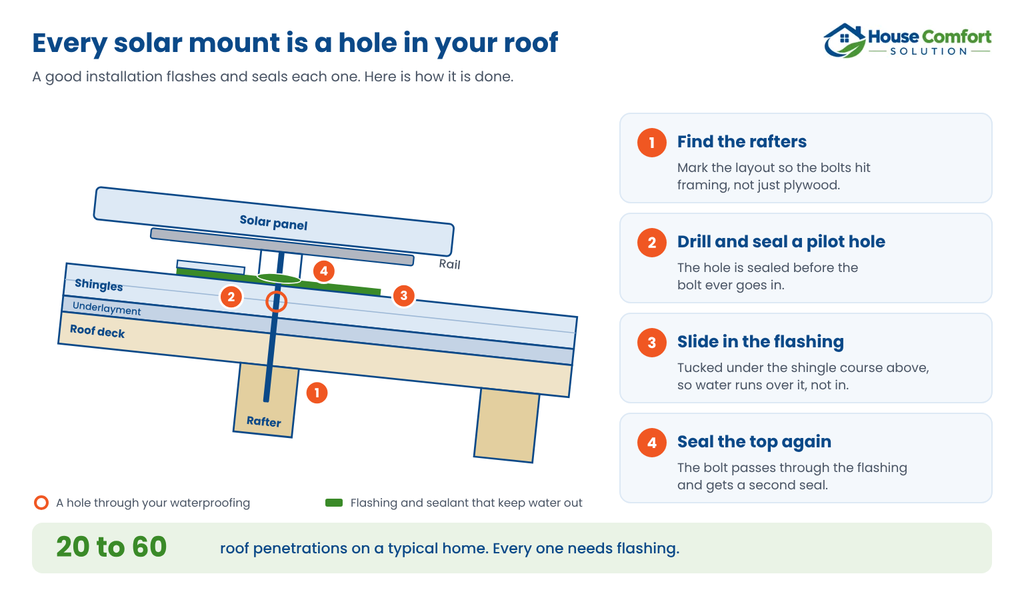
The difference is invisible from the ground, which is why the flashing method belongs in your contract.
The shortcut we see most often is a mount screwed down with surface sealant only. Every sealer looks good the first day, but it wears off after a few years.
Are there mounting options with no roof holes?
Yes, depending on the roof.
| Mounting option | Best for | How it works |
| Seam clamps | Standing-seam metal | Clamps grip the raised seam, so nothing pierces the metal panels |
| Ballasted racking | Flat roofs (TPO, EPDM, built-up) | Weight of the frame and concrete blocks holds the array down |
| Adhesive-mounted systems | Some low-slope and shingle roofs | Structural adhesive bonds the mounts; fewer holes, but newer and less proven long term |
| Tile hooks or replacement mounts | Clay and concrete tile | Hooks go under the tile, or a flashed mount replaces a tile |
No-penetration does not mean no-risk. Ballasted systems add weight, and adhesives depend on clean, sound roofing underneath.
6 Ways Solar Panels Can Actually Damage a Roof
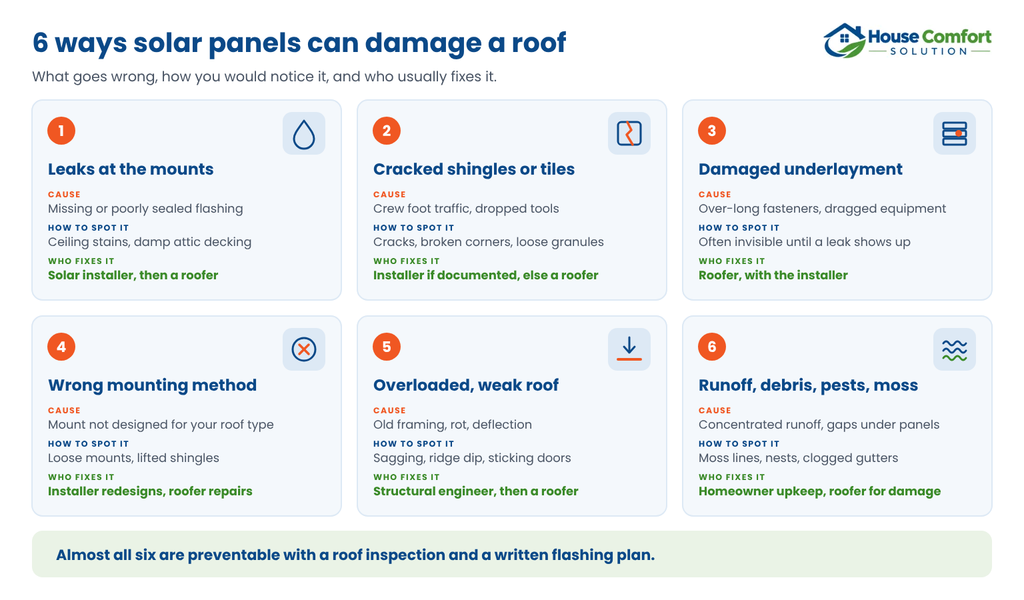
Here is the short list of what goes wrong, who usually ends up fixing it, and how you would notice it. Details on each follow the table.
| Problem | Typical cause | How to spot it | Who fixes it |
| Leaks at the mounts | Missing or poorly sealed flashing | Stains on the ceiling below the array, damp attic decking around a bolt | Solar installer (penetration warranty), then a roofer for the roofing repair |
| Cracked shingles or tiles | Crews walking on the roof, dropped tools | Cracks, broken corners, loose granules near work areas | Installer if documented, otherwise a roofer |
| Damaged underlayment or membrane | Over-long fasteners, dragged equipment, punctures | Often invisible until a leak shows up | Roofer, with the installer if the damage is tied to the install |
| Wrong mounting method | Mount not designed for your roof type | Mounts loosening, lifted shingles, early leaks | Installer redesigns; roofer repairs the roof |
| Overloaded or weak roof | Old framing, rot, deflection | Sagging, ridge dip, doors that stick | Structural engineer, then a roofer or framer |
| Runoff, debris, pests, moss | Water shed below the array, gaps under panels | Wet streaks, moss lines, nesting material, clogged gutters | Homeowner maintenance, roofer for any damage |
1. Leaks from poor flashing and sealing at the mounts
This is the major one. It only takes a small hole for water to get in, and a roof mount will let water in for 25 years. If the flashing is not woven under the shingle above, or the sealant was the only protection, water works its way into the decking.
The frustrating part is how slowly it shows. A leak at a mount can drip into insulation for a year before a stain appears on the ceiling. If you are tracing a leak, you can read our guide on how to find a roof leak source walks through the checks, and the roof leak repair guide covers what repairs involve and what they cost.
2. Cracked shingles or tiles from foot traffic
An install crew may spend two days on your roof carrying panels, rails and tools. Asphalt shingles get brittle in cold weather and can crack under a boot. In summer heat, the granules scuff off, and the mat underneath is exposed. Clay and concrete tiles are worse. They break under concentrated weight, and a cracked tile can be invisible from the ground. A careful crew uses roof jacks, walkway boards and a plan for where to step. A careless one just walks the roof.
3. Damaged underlayment or membrane
What sits under the shingles is your second line of defense. A fastener that is too long, a pilot hole drilled in the wrong spot, or a hard drag of equipment across the surface can puncture the underlayment on a shingle roof or the membrane on a flat one. The roof may look perfect and still be compromised.
4. The wrong mounting method for your roof type
An attachment that works on asphalt shingles can be a bad idea on tile, metal or a low-slope roof. Using a standard shingle mount on a tile roof, or screwing through a metal panel instead of clamping the seam, are the classic examples. Ask the person who put the mount on your roof how it was picked for your roof and not for all roofs.
5. Extra weight on a weak or old roof
Solar adds a modest load per square foot. On a sound roof that is not an issue. On a roof with sagging rafters, past water damage or rot, it can be the extra stress that shows an existing problem. More on this in the weight section below.
6. Water runoff, debris, pests and moss under the array
Panels change how water runs off your roof. Rain collects at the lower edge of the array and sheds in a concentrated line, which can wear on shingles and overload gutters. Leaves and pine needles pile up under panels, and where there is a warm, sheltered gap, squirrels, birds and rodents move in and chew wiring. Moss tends to grow along the shaded edges. None of this is dramatic, but over several seasons it adds up.
Solar Panels on Different Roof Types
The roofing material under the array changes the risk factor, the mounting hardware and the repair bill if something goes wrong.
Asphalt shingle
Asphalt shingle is the most frequent and easiest roof to install. It is also the roof where flashing quality matters most, because every mount is a through-roof penetration. Shingles are also the least forgiving of foot traffic and of age. A shingle roof with granule loss, curling or brittle tabs should be replaced before solar goes on.
Clay and concrete tile
Tile is heavy, brittle and expensive to repair. Installers either use hooks that slide under the tile or swap in a flashed mount in place of a tile. Both work when done by a crew that knows tile. Expect some tiles to crack during installation, so ask whether matching spares are on hand. Older clay tile can be hard to match, and some tile roofs also need the underlayment checked, since the tile itself is not the waterproofing layer.
Standing-seam metal
This is the best case for solar. Clamps grab the raised seams and hold the rails, with no holes in the panels. The details that matter are the clamp style matching your seam profile and the panel gauge being thick enough to carry the load. Never allow an installer to screw directly through a standing-seam panel.
Flat roofs (TPO, EPDM)
Flat and low-slope roofs usually take a ballasted racking system, so the array is held down by weight rather than bolts. That avoids the membrane punctures, but it concentrates load and traps debris and water against the membrane. Before installation, the membrane should be inspected and any aging seams or ponding areas repaired.
Leak data from drill-free arrays is encouraging. In Singapore, a five-year record covering roughly 2,900 public housing blocks with ballasted rooftop solar logged only about 76 reported roof leaks. That is a small number, though it comes from one country and one building type, so treat it as a good sign, not a guarantee.
Does Your Roof Need Replacing Before You Go Solar?
If your roof has fewer than 10 years left, yes, it almost always makes sense to replace it first. A solar array is designed to last around 25+ years. A roof that cannot last that long will have to be torn off while the panels are on it.
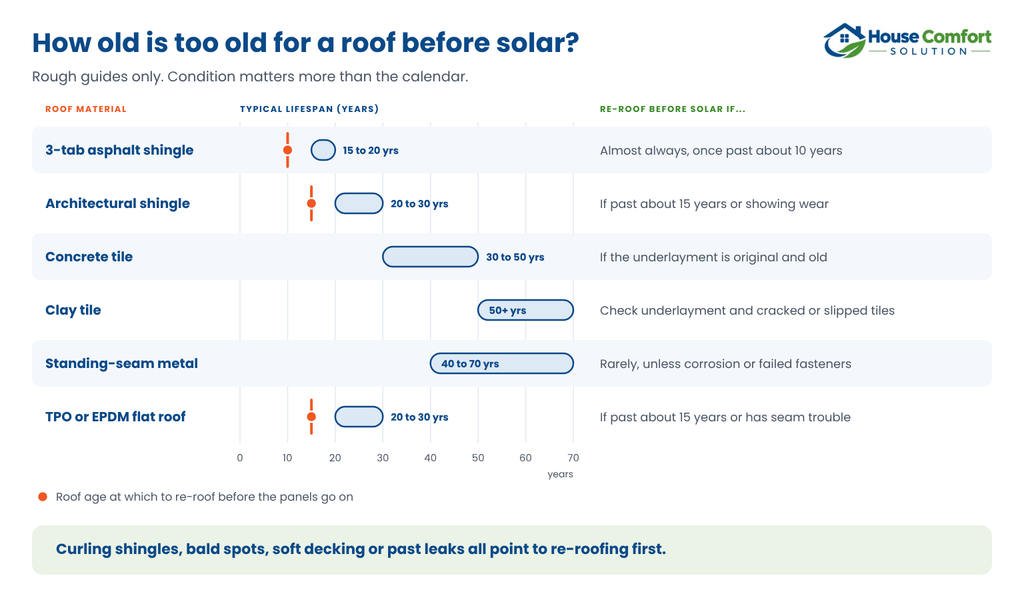
How old is too old?
Use these as rough guides. Condition matters more than the calendar.
| Roof material | Typical lifespan | When to re-roof before solar |
| 3-tab asphalt shingle | 15 to 20 years | Almost always, once it is past about 10 years |
| Architectural asphalt shingle | 20 to 30 years | If it is past about 15 years or shows wear |
| Concrete tile | 30 to 50 years | Check underlayment age; replace it if it is original and old |
| Clay tile | 50+ years | Check underlayment and any cracked or slipped tiles |
| Standing-seam metal | 40 to 70 years | Rarely, unless there is corrosion or failed fasteners |
| TPO or EPDM flat roof | 20 to 30 years | If it is past about 15 years or has seam trouble |
Also look at what the roof is telling you. Curling or cupping shingles, bald spots where granules have worn off, soft decking, and a history of leaks all point to replacing it before panels go on.
Either way, finish the roof work before the panels go on. A later tear-off means detach and reset.
Why you can’t re-roof with panels in place
The new roofing has to be installed on a bare deck. That means the panels, rails and mounts are removed, the roof is replaced, and then the system is reinstalled. This is called detach and reset. The system is shut down while this happens, which means no solar production for days or weeks, and you will need a roofer and a solar company coordinated so the schedule does not drag on.
What it costs to remove and reinstall panels
The cost depends on system size, roof access and local labor rates. For a typical home, detach and reset commonly runs a few thousand dollars, and larger systems or hard-to-reach roofs push it higher. It is real money, but it is far less than the cost of a mid-life tear-off done on a 25-year-old system. Get a quote from the solar company for the detach and reset before the roofing quote, so you can see the total.
Re-roofing first means one project, one inspection and a fresh roof underneath the panels for their whole working life.
Can Your Roof Handle the Weight?
In almost every case, yes. A typical residential roof is built with a good margin, and a solar array is lighter than most people expect.
What panels add vs. what roofs are built for
A standard panel weighs roughly 40 to 50 pounds. Spread across the roof with rails and mounts, a rooftop array adds about 2 to 4 pounds per square foot. Roofs are designed for much more than that.
| Load | Approximate weight per square foot |
| Solar array with racking | 2 to 4 psf |
| Minimum design live load for residential roofs | 20 psf |
| Snow load in cold regions | Often 30 psf or more, depending on location |
The live load number is a design allowance for people, equipment and temporary loads. It does not mean your roof has 20 psf to spare once you add the roofing materials and local snow. Assuming the roof is in good shape is the most critical aspect.
When you need a structural engineer
Most installers do a basic structural check, and many jurisdictions require an engineer’s letter. Push for a full engineering review if any of these apply:
- The house is older than about 40 years, or the framing was clearly altered
- You can see sagging, a dipped ridge or bowed rafters
- Insects, water, or decay have caused damage in the attic in the past.
- You live in a heavy-snow area
- The plan uses ballasted racking on a flat roof
- The roof is made of engineered trusses that haven’t been changed in a long time.
A few hundred dollars for an engineer is cheap compared to repairing a roof that has started to sag.
Do Solar Panels Protect Your Roof? What the Evidence Shows
There is a real argument that panels shield the roofing beneath them. The research behind it is promising, but it is thinner than the marketing suggests.
UV, heat and weather shielding
Panels shade the shingles from direct sun, and the shade lowers roof temperatures. A University of California San Diego study measured about 38 percent less heat reaching the roof under the panels than on the exposed section. Field measurements on shingle roofs have also found peak shingle temperatures 5 to 15°C (roughly 9 to 27°F) lower beneath arrays. Less heat and less UV generally means slower aging of the shingle surface.
Panels also take hail, falling branches and wind-driven rain before the shingles do. A scale-model wind-tunnel study found that arrays can reduce wind force on the roof surface by around 45 to 63 percent in some conditions, which could help against wind uplift.
| Protective effect | What the research found | How solid the evidence is |
| Lower roof temperature | About 38% less heat reaching the roof in one study; 5 to 15°C lower peak shingle temperatures in field work | Good, but short-term and small samples |
| UV shielding | Direct sun is blocked under the panels | Strong in principle |
| Wind uplift reduction | 45 to 63% lower wind force in scale-model tests | Early; models are not full roofs |
| Hail and debris | Panels absorb some impacts | Real-world results vary with hail size |
What we still don’t know about roof lifespan
Nobody has 25 years of data showing that a shingle roof under solar outlasts the same roof without it. The UCSD work covered three days in April on one building. The wind-tunnel results come from scale models. And there are possible downsides: heat trapped in the gap, water and debris collecting at the edges, and shaded areas that stay damp.
Our read from the field is that a roof in good condition underneath the panels tends to look better than the exposed sections around them. That is an observation, not a guarantee, and it does not mean installation damage and neglected maintenance are off the table.
Will Solar Void Your Roof Warranty?
Not automatically. Solar does change who is responsible for what, and that is where homeowners get caught. Know the answer to “who covers a leak at a mount?” before the first bolt goes in.
Shingle manufacturer warranties
Major shingle makers generally keep the warranty in place when a qualified installer follows their guidelines and does not damage the roofing. What they do not cover is damage caused by the installation itself or by the penetrations. This breakdown of manufacturer positions covers how the policies differ.
If you want to use a general rule, don’t. Terms change for each brand and level of guarantee. Find your shingle line and installation date, request the current warranty wording, and ask the manufacturer or your roofer whether panel mounting needs any approval or specific hardware.
Roofer vs. solar installer warranties
These are two separate promises with a gap between them.
| Warranty | Covers | Usually does not cover |
| Roofer’s workmanship warranty | Defects in the roofing work the roofer did | Penetrations or damage made by other trades, including solar crews |
| Shingle manufacturer warranty | Material defects, sometimes with limits on labor | Damage from installation, foot traffic and mounts |
| Solar installer’s roof penetration warranty | Leaks tied to the mounts and installation | Existing roof wear, unrelated failures, or damage from other causes |
Penetration warranties from solar installers commonly run around 10 years, though some are longer and some are shorter. The shorter the term, the more the leak risk sits with you for the second half of the system’s life.
Who pays if the roof leaks?
It depends on where the water came in and what caused it.
| Situation | Who is usually responsible |
| Leak at a solar mount, within the penetration warranty | Solar installer |
| After the entry guarantee is over, there is a leak at a mount. | You, or your homeowners policy if the cause is a covered event |
| Shingle failure unrelated to the panels | You, or the shingle manufacturer if it is a covered defect |
| Roof damaged by the install crew (cracked tiles, torn membrane) | Solar installer, if you documented the condition beforehand |
| Storm or hail damage to the roof and array | Homeowners insurance |
| Installer is out of business | You and your insurer; the warranty is only as good as the company |
Photo documentation before and after the job makes most of these disputes simple. Without it, the installer can claim the damage was already there.
Homeowners Insurance and Roofs With Solar
Panels are usually treated as part of the home, but the roof underneath them draws closer scrutiny from insurers. Three things come up again and again:
- Roof age. Many carriers cap payouts at actual cash value for older roofs, and some will not renew or will add surcharges once a roof passes about 15 to 20 years. An old roof with panels on it is the worst combination.
- Workmanship exclusions. Damage from things like hail, wind, and falling trees is covered by insurance. A leak from poorly installed flashing is often classed as faulty workmanship and denied. That is why the installer’s penetration warranty matters.
- Coverage limits. The array adds value to the home. If your dwelling coverage has not been updated, a total loss could leave you short.
Before installation, call your agent, tell them about the system, and ask these questions:
- Is the array covered under my dwelling coverage, and does the limit need to go up?
- Do you require an inspection or documentation of the roof?
- Does my policy pay actual cash value or replacement cost on the roof?
- Are there exclusions for leaks tied to the mounting hardware?
Keep the permit, final inspection record and the installer’s warranty paperwork with your insurance file.
Signs Solar Is Damaging Your Roof (and What to Do)
Catching a problem early is the difference between a flashing repair and a rotted deck. Check the roof and the attic a couple of times a year, and after every big storm.
Warning signs to look for
From the inside:
- Brown or yellow stains on ceilings, especially below the array
- If you notice wet insulation, dark decking, or a musty smell in the attic,
- Daylight or moisture around bolts coming through the roof deck
- Drywall that is cracking or paint that is peeling off of an outside wall
From the outside:
- Roof shingles or tiles that are cracked, lifted, or missing near the array
- Sealant that has dried, cracked or pulled away from mounts
- Rust streaks below fasteners
- Heavy granule buildup in the gutters
- Moss, debris or animal nests under or around the panels
Is it the solar or the roof? How to tell
Location is the biggest clue. A leak or stain that lines up with a mount points to the solar install. Weather or aging is likely to blame for damage that has spread across the roof and away from the array. Timing helps too. Trouble within the first couple of years after installation is more likely tied to the mounts.
First steps: document, call the installer, get a roofer’s inspection
- Document everything. Take up-to-date images of the stain, roof, and array. Note when it rained and how long it took to show.
- Call the installer in writing. Email the photos and reference your warranty. Put the date on record.
- Get an independent roofer’s inspection. A written report on the cause and repair scope is useful for the installer and your insurer.
- Protect the interior. Contain the water, move belongings and dry the area to prevent mold.
- Allow no one to use tar or caulk to fix it. A quick patch may hide the cause and can complicate a warranty claim.
How to Protect Your Roof Before, During and After Installation
People damage solar roofs most of the time because they aren’t ready or don’t have enough papers. These steps cost little and protect you for the life of the system.
Before: roof inspection and photo documentation
- Have an independent roofer inspect the roof, the decking from the attic and the flashing details. Do this before you sign the solar contract.
- Fix or replace anything that will not last another 25 years.
- Take dated photos of every roof slope, the ridge, valleys, vents and the attic underside. If there is a dispute, these are the ground rules.
- Get the installer’s mounting plan in writing, with the attachment type, flashing method and layout.