Depending on how well it is taken care of, the weather, and the material, a roof can last anywhere from 15 to more than 100 years. Roofs come in different types like, asphalt shingles, can last for 15 to 30 years. Metal roofs usually last between 40 and 70 years. Tile and slate often last 50 years. Slate can top 100. The weather, attic airflow, and upkeep move those numbers up or down. In this article, we will explain the type of roofing, material, how long they last, and how you can maintain it.
How Many Years Does Each Roof Type Last?
Slate and tile endure longer than other types and can last from 50 to 200 years, depending upon the type of material and maintenance. Basic 3-tab shingles wear out first. InterNACHI, a home inspector group, lists about 20 years for 3-tab shingles, 30 for architectural shingles, 40 to 80 for metal, and 60 to 150 for slate.
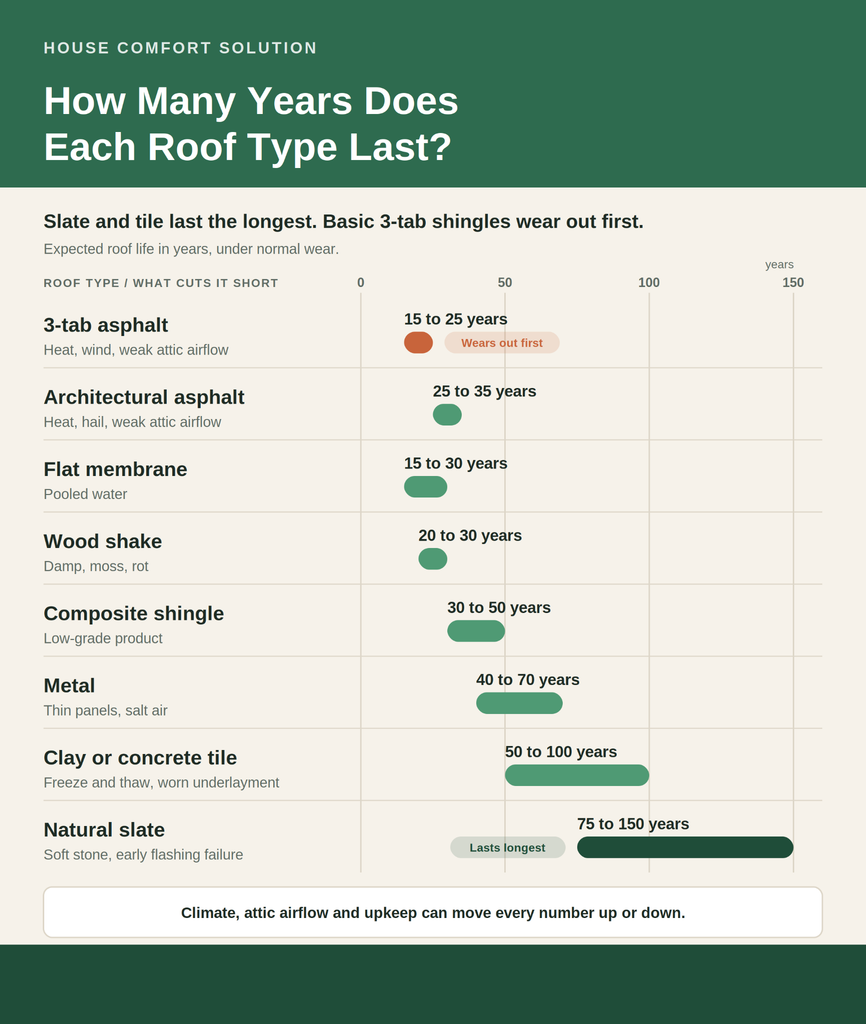
The table below adds what cuts each life short.
| Roof type | Expected life | What cuts it short |
| 3-tab asphalt | 15 to 25 years | Heat, wind, weak attic airflow |
| Architectural asphalt | 25 to 35 years | Heat, hail, weak attic airflow |
| Flat membrane | 15 to 30 years | Pooled water |
| Wood shake | 20 to 30 years | Damp, moss, rot |
| Composite shingle | 30 to 50 years | Low-grade product |
| Metal | 40 to 70 years | Thin panels, salt air |
| Clay or concrete tile | 50 to 100 years | Freeze and thaw, worn underlayment |
| Natural slate | 75 to 150 years | Soft stone, early flashing failure |
Why Does a “25-Year” Shingle Fail at Year 15?
Firstly, a 25-year label is a warranty term. It doesn’t promise how long your roof will last.A “25-year” asphalt shingle usually fails after 15 years. This is because the sign only shows the manufacturer’s promise under ideal lab tests, not how long the shingle will last in real life. Standard three-tab or baseline architectural shingles have a lifespan of twelve to twenty years when exposed to the weather conditions in their natural environment.
| Who reports it | Roof type | Reported life |
| Local roofer in a TV Q&A | 25-year asphalt shingle | 12 to 15 years |
| Maryland roofer | 20-year asphalt shingle | 15 to 17 years |
| Roofer’s guide on Florida homes | Asphalt shingle | 15 to 20 years |
Sources also disagree for another reason. InterNACHI says its figures assume normal wear. Extreme weather, neglect, and abuse are not included. You should treat every published number as a range, not a promise.
How Long Does Each Material Hold Out?
Asphalt shingles under sun and snow
The average lifespan of an asphalt roof is 15 to 30 years. Basic 3-tab shingles sit near 20 years. Thicker architectural shingles reach about 30 years. Sun dries out the asphalt. Freeze & thaw cycles crack it. Hot states cut the span more.
Metal roofs against storms
Steel and aluminum roofing materials typically last between 40 to 70 years as well. Copper and zinc often run 60 to 100 years. Panel thickness matters. Thin steel in the 26 to 29 gauge range may last only 20 to 25 years. Near the coast, aluminum or zinc resists salt air better than bare steel.
Clay and concrete tile in heat
Tiles made of clay and concrete may last between fifty to one hundred years. The layer under the tile often wears out first. That layer is the underlayment. Between age of twenty to twenty-five, you should to get it inspected. Replacement usually falls between years 25 to 40. Tile also weighs up to 950 pounds per 100 square feet. The roof frame must carry that load.
Slate that outlives the house
Natural slate lasts 75 to 150 years. Some slate roofs outlive the house under them. The metal flashing and underlayment often fail sooner. Harder slate grades last longer than soft ones. A roofer with real slate experience should install it.
Wood, composite and flat roofs
Wood shakes last 20 to 30 years. They need dry air and clean surfaces. Composite shingles last 30 to 50 years. Quality varies by brand. Flat membrane roofs last 15 to 30 years. Pooled water is their main killer.
Which Weather Chews Through a Roof Fastest?
Heat, ice, hail, salt air and damp each attack a roof in a different way. The table shows who gets hit hardest.
| Weather | What it does | Hits hardest |
| Heat and sun | Dries out asphalt and speeds wear | Asphalt shingles |
| Freeze and thaw | Water expands in cracks and splits material | Asphalt, tile, flat roofs |
| Hail and wind | Strips granules, cracks tile, lifts shingles | Asphalt, tile |
| Salt air | Corrodes metal parts | Steel and fasteners |
| Humidity | Grows moss, algae and rot | Wood, asphalt |
The U.S. Department of Energy says standard roofs can reach 150°F or more in summer sun. A reflective cool roof can run up to 50°F cooler. Roofers use a simple rule for harsh regions. Home Genius Exteriors, a U.S. external contractor, recommends deducting 5 to 10 years from the lifespan estimate for your roofing type.
What Hidden Parts Age a Roof From the Inside Out?
The structural deck, underlayment, attic airflow, and internal moisture dynamics are hidden parts of a roof that age it from the inside out. Instead of starting with the roofs on the outside, damage often starts quietly below the surface.
- Attic airflow. Vents that are blocked or not working right keep hot air and moisture in the attic. This “bakes” the shingles from the bottom when it’s hot, and it causes condensation and rot when it’s cold.
- Underlayment. This secondary moisture shield, which is right under the shingles, breaks down when it is exposed to heat & water. Water goes right to the decks and the back of the shingles once it breaks down.
- Flashing. Seals made of metal or rubber that seal around vent pipes, skylights, and chimneys crack or come loose. This lets water and condensation get into the insulation and framing without being seen.
- Installation. Poor nailing and sealing reduce the lifespan of roofs. Faults often stay hidden for five to ten years.
- Slope and drainage. Steep roofs shed water fast. Flat sections need clear drains.
What Does a Roof Look Like at Year 5, 15 and 25?
From year 5 to year 25, an asphalt shingle roof ages significantly due to the sun, wind, and rain wearing down the protective materials.
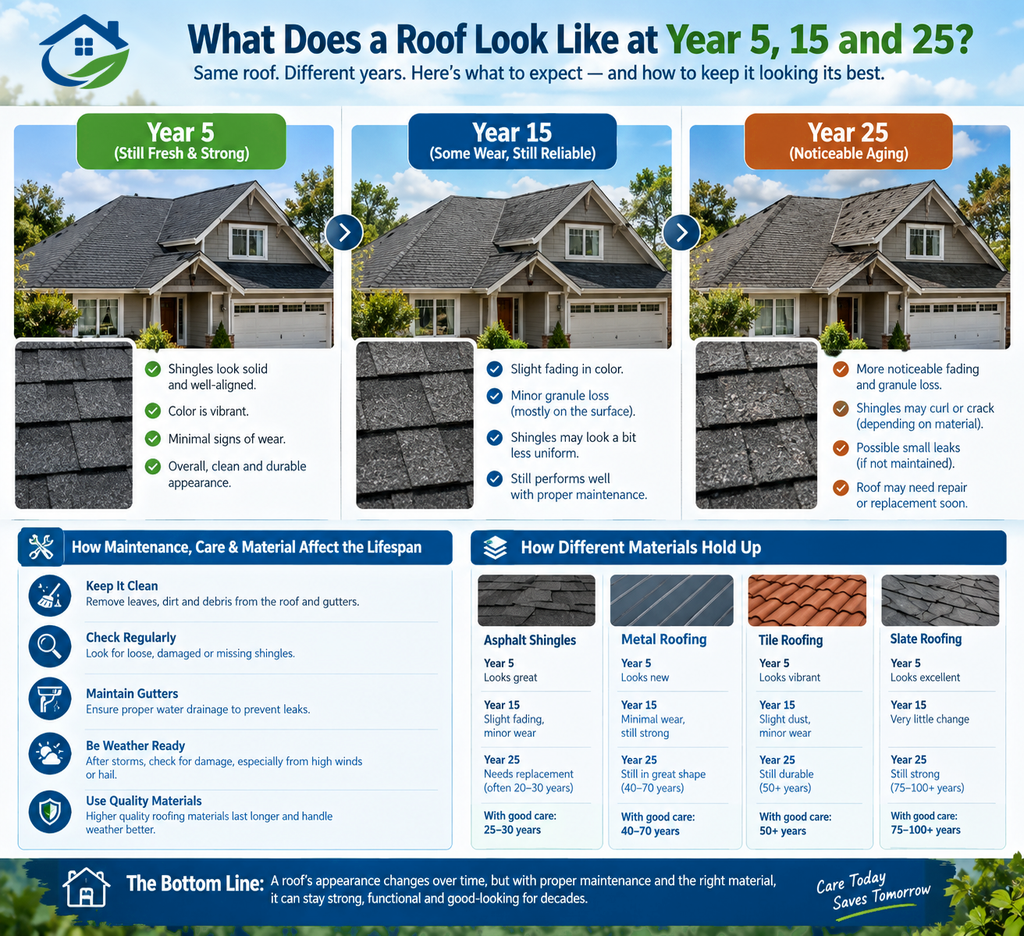
Your roof may age faster or slower. Climate and care set the pace.
How Do You Find Your Roof’s Real Age?
Most of the time, paper records give the most accurate age. Wear on the roof gives only a rough guess.
| Where to look | What it shows |
| City or county permit file | Install date and sometimes the warranty |
| Home sale papers or inspection report | Roof age, if the seller or inspector listed it |
| Contractor invoice or warranty card | Install date and shingle line |
| The roof itself | Curled edges and granule loss hint at age |
Wear can mislead. One home inspector reports a roof that looked 20 years old but was only 2. Poor attic ventilation ages a roof fast. You should trust a dated record over your eyes.
Which Signs Say Your Roof Is Running Out of Years?
Six signs matter most.
Curled, cracked or buckled shingles: As shingles age, their flexibility decreases, which can cause the edges of the roof to cup upward or fractures to spread over the surface.
Age: As I told you before, asphalt shingle roofs can usually last between 15 to 30 years, with most of them lasting 20 years or more before they start to fall apart.
High Granule Loss: There will be bald spots on the shingles, and a lot of mineral granules that look like sand will build up in the gutters.
Flashing Failure: There are rusting spots, gaps, or dry, cracked covers on the metal flashing around vents, chimneys and windows
Sagging Rooflines: If there are dips or waves along the ridge or rafters, it means that water is getting trapped and rotting the wood below (decking or framing).
Daylight stains in the attic: On a sunny day, you can see light beams going straight through the roof boards when you look up from the attic.
Many leaks and stains on the ceiling: On the inside walls and ceilings, there are brown, yellow, or gray water spots, bubbling paint, or active drips.
Frequent Fatigue Repairs: A contractor to make repairs to the roof has become expansive that occurs on a seasonal or regular basis.
How Can You Add Years to Your Roof?
You can save your roof with these seven habits. They can increase the life of roofs.
- Ground-level checks each spring and fall, and after big storms
- Gutter cleaning after leaf fall and again in early spring
- Branches trimmed back 6 to 10 feet
- Loose shingles and cracked flashing fixed fast
- No pressure washers, which strip protective granules
- Clear soffit and ridge vents
- A pro inspection every 2 to 3 years, or yearly in harsh climates
Simple math shows the payoff. A $12,000 roof that lasts 25 years costs $480 a year. Good care plus maintenance can increase the lifespan to 30 years. The cost then drops to $400 a year. Those numbers are examples, not quotes.
How Long Will Your Roof Last?
In short, roofs can last on any location from 15 to 100 years or more, depending on the material used, how well it is maintained, and the weather. These are the three main points. A 3-tab roof needs a plan by year 15. An architectural shingle roof needs one by year 25. Metal and tile roofs give you decades more. Slate can outlast you. You should find its age first, then match it to the table above.