

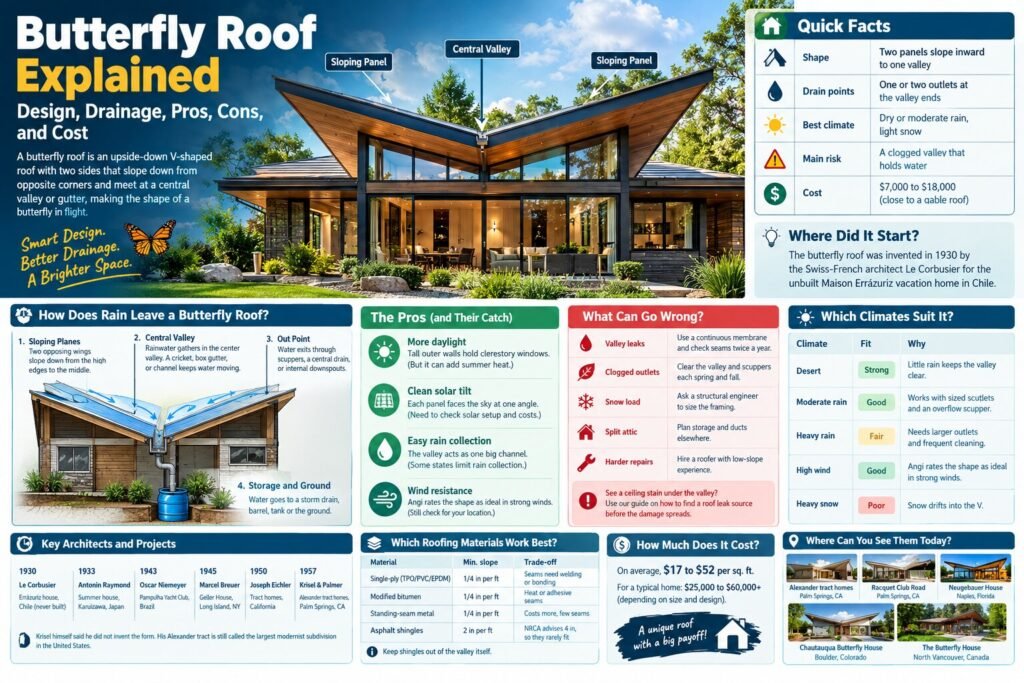
A butterfly roof is an upside-down V-shaped roof with two sides that slope down from opposite corners and meet at a central valley or gutter, making the shape of a butterfly in flight.
You can see the table below.
| Fact | Detail |
| Shape | Two panels slope inward to one valley |
| Drain points | One or two outlets at the valley ends |
| Best climate | Dry or moderate rain, light snow |
| Main risk | A clogged valley that holds water |
| Cost | $7,000 to $18,000, close to a gable roof |
Where did the butterfly roof start?
The butterfly roof was invented in 1930 by the Swiss-French architect Le Corbusier; he first one who iofficaly invested the butterfly roof in 1930 for the unbuilt Maison Errázuriz vacation home in Chile.
| Year | Architect | Project |
| 1957 | William Krisel and Dan Palmer | Alexander tract homes, Palm Springs, California |
| 1950 | Joseph Eichler | Tract homes in California |
| 1945 | Marcel Breuer | Geller House, Long Island, New York |
| 1943 | Oscar Niemeyer | Pampulha Yacht Club, Brazil |
| 1933 | Antonin Raymond | Summer house, Karuizawa, Japan |
| 1930 | Le Corbusier | Errázuriz house, Chile, never built |
Krisel himself said he did not invent the form, according to Wikipedia’s butterfly roof history. His Alexander tract is still called the largest modernist subdivision in the United States.
How does rain leave a butterfly roof?
When it rains on a butterfly roof, the high walls on the outside slope inward to form a V-shaped valley in the middle. The rain then flows off the building through a special draining system. A butterfly roof has no gutters on its edges.
Planes with a slope: Two opposing wings slope down from the high edges to the middle of the building, making a V-shape or inverted gable.
Central Valley: Rainwater gathers in the center valley after flowing down both surfaces once it has been collected. A cricket, which is a peaked structural ridge, may be installed in this valley, together with a box gutter, a channel that slopes, or a cricket, in order to keep water going.
Out point: From the valley toward the extremities or a depression, exiting through scuppers, a central drainage aperture, or internal downspouts.
Storage and Ground: A storm drainage system, a rainwater collecting barrel or storage tank, or the ground are the destinations of the water that is sent downward by the downpipes, whether they are internal or exterior.
What do you gain from a butterfly roof?
You get four real benefits, and each one has a catch.
- More daylight. The tall outer walls hold clerestory windows that bring in light and keep street views out.
- A clean solar tilt. Each panel faces the sky at one steady angle, so solar mounts line up neatly.
- Easy rain collection. The valley acts as one big channel, so a barrel at the outlet fills fast.
- Wind resistance. Angi rates the shape as ideal in strong winds.
The catch? Big windows add summer heat, and some states limit rain collection. You should check both before you commit.
What can go wrong with a butterfly roof?
Most trouble starts in the valley. Water sits there longest, so any weak seam shows up first.
| Risk | Why it happens | What you should do |
| Valley leaks | Water rests on the valley seams | Use a continuous membrane and check seams twice a year |
| Clogged outlets | Leaves and grit wash into the V | Clear the valley and scuppers each spring and fall |
| Snow load | Snow piles up in the V and adds weight | Ask a structural engineer to size the framing |
| Split attic | The V leaves two small attic spaces | Plan storage and ducts elsewhere |
| Harder repairs | Few roofers work on inverted roofs | Hire a roofer with low-slope experience |
Do you see a ceiling stain under the valley? Use our guide on how to find a roof leak source before the damage spreads.
Which climates suit a butterfly roof?
Warm and dry climates, tropical regions, and desert settings are the ideal conditions for the installation of a butterfly roof. As a result of its inverted “V” form, which slopes inward toward a central valley, it functions as a massive funnel that is very effective at collecting rainfall, yet also causes severe vulnerabilities when the temperature is below freezing.
| Climate | Fit | Why |
| Desert | Strong | Little rain keeps the valley clear, as Palm Springs shows |
| Moderate rain | Good | Works well with sized outlets and an overflow scupper |
| Heavy rain | Fair | Needs larger outlets and frequent cleaning |
| High wind | Good | Angi rates the shape as ideal in strong winds |
| Heavy snow | Poor | Snow drifts into the V, and Angi calls it a poor fit |
How much does a butterfly roof cost?
On average, the cost of installing a butterfly roof ranges from $17 to $52 per square foot when taken into consideration. Over the course of a typical project, the cost might range anywhere from $25,000 to $60,000 or even more for a home of a moderate size or for a comprehensive design and construction.
A butterfly roof is a roof that has a distinctive inverted “V” form that looks like wings in flight, making it more expansive rather than common choices like gable or hip roofs.
Which roofing materials work best?
Pick a material rated for low slopes. Most butterfly panels are too shallow for shingles.
| Material | Minimum slope | Trade-off |
| Single-ply membrane (TPO, PVC, EPDM) | 1/4 inch per foot | Seams need careful welding or bonding |
| Modified bitumen | 1/4 inch per foot | Seams need heat or adhesive |
| Standing-seam metal | 1/4 inch per foot | Costs more, but has few seams |
| Asphalt shingles | 2 inches per foot | NRCA advises 4 inches, so they rarely fit |
The slope figures come from the code minimums listed by Professional Roofing. Keep shingles out of the valley itself.
How do you keep a butterfly roof mantain?
Keep the valley clean, and the roof will treat you well. You can follow the routine below.
- Spring: clear leaves, seeds, and grit from the valley and scuppers
- After big storms, check that the roof drains within 48 hours
- Fall, clean the outlets again before the leaves drop
- Winter, pull heavy snow out of the valley with a roof rake from the ground
- Twice a year, inspect valley seams and wall flashing
- Once a year, test the overflow scupper with a hose
The 48-hour mark matches the code definition of positive drainage. You should also check the our article on 10 common causes of roof leaks shows what else to watch.
What do building codes and insurers ask?
Most US states base their home rules on the International Residential Code, with local changes. Washington State’s version is a clear example. Where roof drains are required, it calls for overflow drains or scuppers as a backup.
Overflow drains match the main drain size and sit 2 inches above the roof’s low point. Overflow scuppers must be three times the drain size, with an opening at least 4 inches tall.
You should ask your building department three questions.
- Which code edition applies to my address?
- Do I need an engineer’s stamp for snow load?
- Where must overflow water discharge?
Call your insurer before you build, too. Ask how they rate a low-slope roof and how the valley affects your premium.
Where can you see butterfly roofs today?
Palm Springs holds the classic examples. Newer homes show how architects adapt the shape to wet and snowy places.
| Project | Place | Architect |
| Alexander tract homes | Palm Springs, California | William Krisel and Dan Palmer |
| Racquet Club Road Estates | Palm Springs, California | William Krisel |
| Neugebauer House | Naples, Florida | Richard Meier & Partners |
| Chautauqua Butterfly House | Boulder, Colorado | Stephen Sparn Architects |
| The Butterfly House | North Vancouver, Canada | Kevin Vallely Design |