

Just imagine for a second: It is 2 a.m. A drip hits the floor. The stain on the ceiling grows. At this moment, you just think three things. Where does the water enter? How do you stop it? What will the fix cost?
Most roof leaks start where a part breaks the smooth roof surface. A vent pipe, a chimney or a worn strip of flashing is a common culprit. You find the entry point first. Then you stop the water. Then you repair the damaged part. Speed matters. IBHS research puts roof damage in up to 90% of insurance claims after big storms.
Where Does the Water Travel Before It Drips?
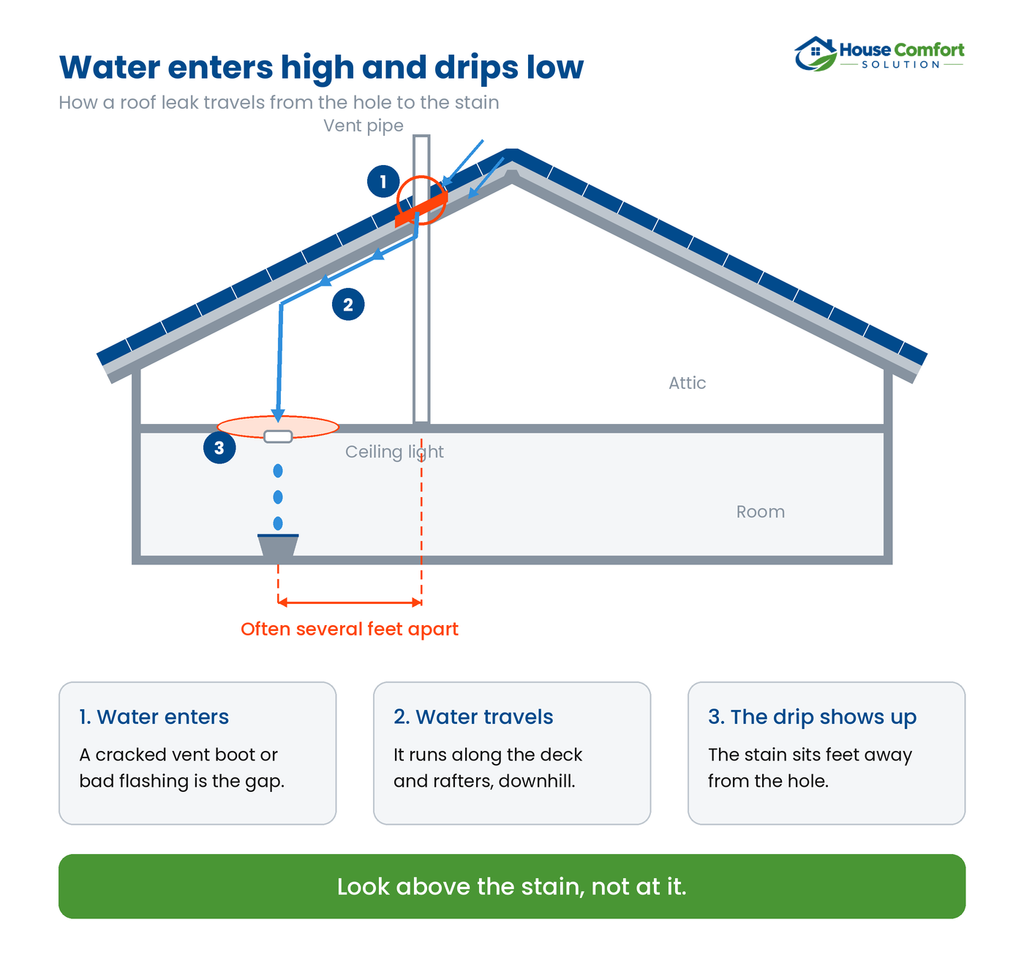
Water does not fall straight down. It runs along the roof deck. Underneath the shingle layer is the deck, which is made of flat boards. Water follows rafters and pipes until it finds a gap. Then it drips into the room. The stain can sit several feet from the hole. The hole almost always sits uphill from the drip. You look above the stain, not at it.
Which Spots on Your Roof Leak Most Often?
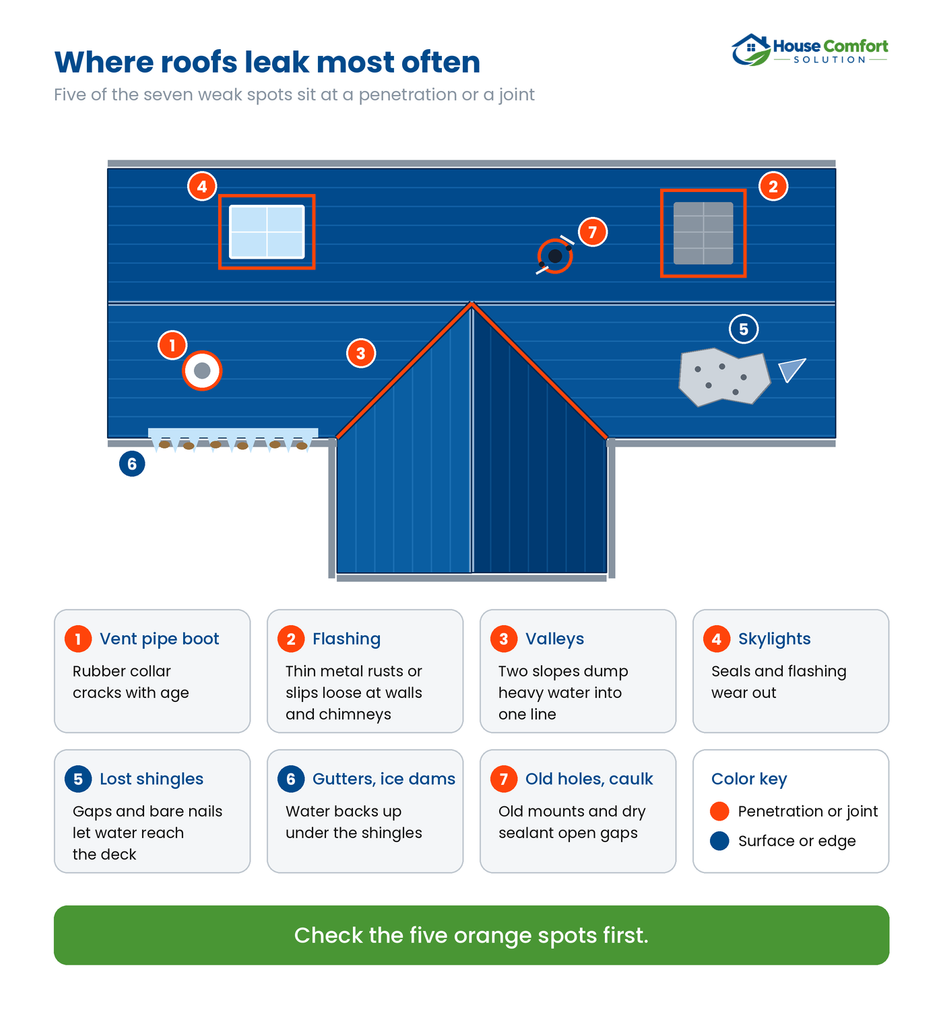
Leaks rarely start in the open field of shingles. They start at weak spots, where one part meets another. A penetration is a pipe, vent, chimney, or skylight through the roof. A U.S. Department of Energy guide calls every penetration a weak spot in the roof’s armor.
| Weak spot | Why it leaks | Clue |
| Vent pipe boot | The rubber collar cracks with age | Water along a pipe in the attic |
| Flashing at walls and chimneys | Thin metal rusts or slips loose | A stain beside a wall or chimney |
| Valleys | Two slopes dump heavy water into one line | Streaks under the line where slopes meet |
| Skylights | Seals and flashing wear out | A drip near the skylight edge |
| Damaged or lost shingles | Gaps and bare nails let water reach the deck | Bare spots or lifted tabs from the ground |
| Clogged gutters and ice dams | Water backs up under the shingles | Stains near the roof edge |
| Old holes and dry caulk | Leftover mounts and cracked sealant open small gaps | A slow stain with no clear source |
Five of the seven spots sit at a penetration or a joint. You should check those first. Family Handyman’s guide agrees. Leaks rarely form in open shingle areas.
How Do You Find the Exact Entry Point?
When you find it, it often takes longer than the fix. Some experts say to expect an hour or more. You work in order. You check the attic first. You look for dark stains, wet insulation and water trails under the deck.
- You look for shiners. A shiner is a nail that missed the rafter. It frosts on cold nights and drips on warm days.
- You trace the stain uphill. You check pipes, vents, chimneys and walls on the way.
- You run a hose test with a helper. The helper waits in the attic. You soak one small area at a time, from low to high, for several minutes each.
- You call a roofer if the source stays hidden. IBHS says you shouldn’t lift roofs to see what’s under them. The lift breaks the sealant strip under each shingle.
What Can You Do Tonight to Stop the Damage?
A temporary step only limits the damage. It does not fix the roof. You can use a bucket or tarp under active leaks, clear furniture and mark leak spots for your contractor. Safety comes first. You stay off a wet roof.
- Things like furniture, rugs, and electronics were moved away from the drip
- A bucket under the drip and a tarp under the bucket
- A pencil mark around the stain edge, with the date
- There was a single, tiny drain hole cut into the side of a bloated roof at the very bottom.
- A roof tarp from the ridge to the eave, placed by a pro on a steep or wet roof
A tarp only works on a dry, safe roof. A pro should handle steep roofs.
How Do You Fix Each Leak, Step by Step?
You match the fix to the failed part. A strong repair replaces the part. A weak repair only hides the hole.
1. A Cracked Vent Boot or Roof Vent
A vent boot is the collar around a pipe. Rubber cracks with age. If the boot is broken, water can flow down the pipe.
- You pry up the shingles beside the boot with a flat bar.
- You pull the old nails and slide out the old boot.
- You slide the new boot under the upper shingles. The shingles below rest on top of the bottom border.
- You fasten it with rubber-washer screws and cover each screw head with sealant.
A boot with only loose nails needs new screws. It does not need a new boot.
2. Rusted or Loose Flashing at Walls and Chimneys
When it rains, the flashing will direct the water away from the shingles. Rust or a loose piece lets water slip behind it. Step flashing sits in short layers along a wall. You pry up the shingles over the bad piece. You slide a new piece under the wall boards and over the shingle below. After that, you may put the shingles back on and fasten them with nails.
Chimney flashing often rusts at the bottom bend. A new piece slid under the old one buys time. The best fix cuts a groove in the mortar for new flashing.
3. Valley Leaks
Where two hillsides intersect, you get a valley. It carries a lot of water. Leaves block it, and a worn liner lets water through. You clear the debris and look for rust or holes. A worn liner needs new flashing. That job belongs to a roofer.
4. Skylight Leaks
You check the seal around the glass first. A worn seal gets fresh sealant. Bent or rusted flashing needs a replacement. Cracked glass needs a new pane.
6. Damaged Shingles, Nail Pops and Small Holes
You replace a cracked or lost shingle with one of the same size and type. The old shingle is lifted up, the nails are pulled out, and the new one is slipped in. Then you nail it and seal the tabs. A raised nail head gets pulled and replaced. A small hole from an old mount needs liquid flashing or a metal patch under the shingle.
7. Clogged Gutters and Ice Dams
Clogged gutters push water back under the shingles. You clean them twice a year. Ice dams form when heat escapes into the attic. Snow melts and freezes again at the cold roof edge. Water then backs up under the shingles. Better attic insulation and airflow stop the cycle. A strip of ice-and-water barrier along the edge adds a second layer.
Why Does Caulk Alone Fail?
Caulk and roof cement close small gaps for a short time. Sun breaks sealant down within a few years. You can tar, and sealant also makes a later repair harder. A mechanical fix lasts longer. It replaces the failed part.
Should You Fix It Yourself or Call a Roofer?
Small jobs on low, dry roofs suit careful DIY work. OSHA names falls as the top cause of death in residential construction.
| Good DIY jobs | Jobs for a roofer |
| One cracked shingle | A steep or wet roof |
| A vent boot on a low, dry roof | Soft or low spots in the deck |
| Raised nail heads | Leaks at a chimney, valley or skylight |
| One small hole with liquid flashing | Many damaged shingles |
| A short gutter clean from a stable ladder | Mold or an unknown source |
You pick a dry, warm day. You wear soft-soled boots. A helper holds the ladder.
What Does a Roof Leak Repair Cost?
The average cost to fix a roof leak is between $350 and $1,150, with a usual range of $150 to $1,500. But it also depends on the roofing materials, accessibility, and the origin of the leak these things determine the final price.
| Repair | Typical cost |
| Vent repair / Pipe bot | $200 to $250 |
| Flashing | $200 to $950 |
| Skylight leak | $300 to $800 |
| Roof leak, overall | $350 to $1,500 |
| Ice dam removal | $400 to $1,500 |
What Do Homeowners Ask Most About Roof Leaks?
Can a Roof Leak Cause a Collapse?
A roof that leaks can ultimately collapse, but it’s rather unusual for a newly leaking roof to fall all at once. Without a major failure in the roof structure, most instantaneous collapses occur when the saturated insulation and drywall ceiling give way under the weight of the accumulated water. Years of severe, untreated water rot are often necessary for major structural roof failures.
How Long Can You Leave a Roof Leak?
If your roof is leaking, you should fix it right away. Even a small drip can damage the structure and grow mold in just a few days.
Will Sealant Stop a Leak for Good?
If the system is fractured, under high pressure, or physically damaged, using sealant as a short-term solution will not effectively stop the leak. Leak type, material, and product all have a significant role in determining whether a sealant is permanently effective.
Can You Fix a Roof Leak From the Inside?
There is an inside method to temporarily repair a roof leak, but this will not solve the problem permanently. When you seal a leak from the inside, the symptoms go away and you have more time, but the outside of the roof still needs to be fixed by a professional.







[…] a leak, you can read our guide on how to find a roof leak source walks through the checks, and the roof leak repair guide covers what repairs involve and what they […]